Vaccination against tick-borne encephalitis at the pharmacy
Who the STIKO recommends the FSME vaccination to, which districts count as risk areas in 2026 and which pharmacies offer the vaccination.
As of: 04/09/2026
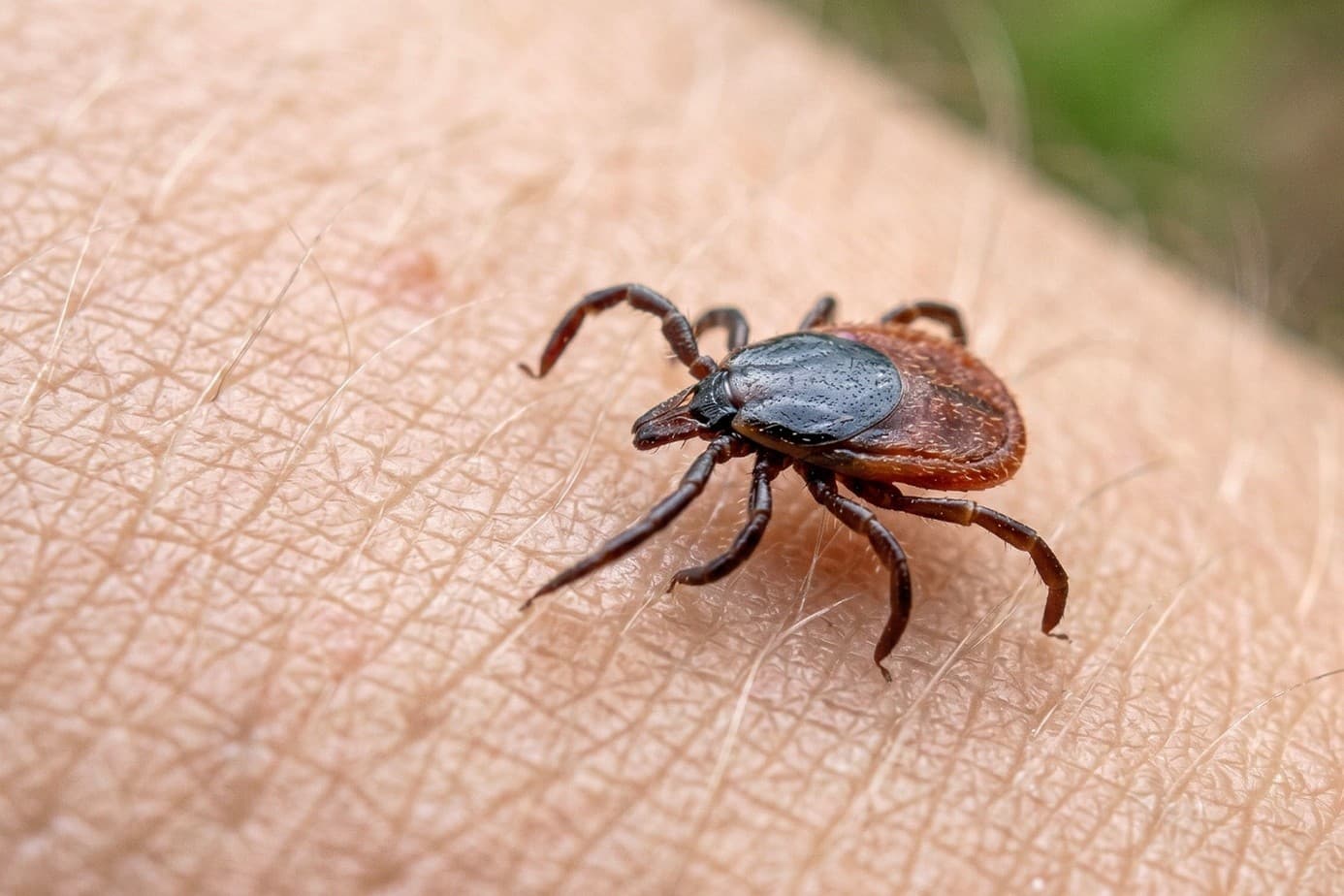
The castor bean tick, Ixodes ricinus, is native to Germany and the tick species found here most often. Ticks are considered the most dangerous animals in Germany, because they carry several pathogens, among them Borrelia bacteria and the virus behind tick-borne encephalitis. Its German name is Frühsommer-Meningoenzephalitis, FSME for short.
A tick takes up pathogens such as viruses during a blood meal on an infected host, for example a rat or a bat. Tick-borne encephalitis is a viral disease, and the virus belongs to the flaviviruses. At a later blood meal the tick can pass that virus to a person. Ticks survive rinsing and even a cycle in the washing machine. They do not bite, they sting, because they have a proboscis and no teeth. Not every tick carries the virus, but one that does passes it on immediately with its saliva. The saliva also numbs the skin, so the sting usually goes unnoticed.
Why the vaccination at the pharmacy is worth having all year
Ticks do not drop from trees, as many people believe. They are brushed off grasses, leaves and bushes. An adult tick has eight legs, a larva six. The virus comes in a European, a Siberian and a Far Eastern subtype.
Climate change adds to tick activity. Winters have grown milder, so ticks are now active all year, and the castor bean tick starts moving at temperatures of 4 to 7 degrees. The German acronym FSME, which names early summer, therefore no longer fits, because ticks are out in November and December too. An appointment for the vaccination suits any time of year.
How the illness runs, and where the vaccination fits
In most cases the infection causes no symptoms at all. Where it does, it often runs in two phases. After a short incubation period, symptoms such as fever appear, much like flu. Many of those affected then feel better again for 2 to 7 days. A second phase can follow, in which the brain and, less often, the nerves are affected. Tick-borne encephalitis can lead to meningitis, an inflammation of the membranes around the brain. It can also lead to meningoencephalitis, an inflammation of the brain itself, or to encephalomyelitis, an inflammation of the spinal cord. Some patients keep neurological problems after the acute illness, which limit their everyday life and their quality of life.
Tick-borne encephalitis is a growing public health problem, and case numbers have risen steadily over the past years.
An effective measure against this potentially serious illness, which can leave lasting damage, is the vaccination. The primary course consists of three doses, and the first booster follows after three years. An incomplete primary course does not give enough protection.
Your pharmacy or your doctor will tell you more about the schedule.
Who can book an appointment at the pharmacy for the tick vaccination
The Ständige Impfkommission is the standing vaccination committee at the Robert Koch-Institut, STIKO for short. It recommends the vaccination to everyone in Germany who lives in a risk area or travels to one. Even a short stop at a motorway service area can mean the risk of a tick bite. The new risk areas in 2026 are the rural district of Nordsachsen and the city of Halle (Saale). At present 185 rural and urban districts are affected. There is also a nationwide occupational recommendation for laboratory staff working with the virus and for people employed in forestry and agriculture. The statutory health insurers cover each dose of the course.
The risk areas in Germany at present, in 2026:
- Baden-Württemberg, except Heilbronn
- Bavaria, except Schweinfurt
- Brandenburg: Oberspreewald-Lausitz, Oder-Spree, Spree-Neiße, Frankfurt (Oder), Elbe-Elster
- Hesse: Odenwald, Bergstraße, Darmstadt-Dieburg, Darmstadt, Groß-Gerau, Offenbach, Main-Kinzig-Kreis, Marburg-Biedenkopf, Fulda
- Lower Saxony: Emsland, Celle
- North Rhine-Westphalia: Solingen
- Rhineland-Palatinate: Birkenfeld
- Saarland: Saarpfalz-Kreis
- Saxony, except Leipzig
- Saxony-Anhalt: Dessau-Roßlau, Anhalt-Bitterfeld, Halle
- Thuringia: Jena, Gera, Saale-Holzland-Kreis, Saale-Orla-Kreis, Saalfeld-Rudolstadt, Hildburghausen, Sonneberg, Greiz, Ilm-Kreis, Schmalkalden-Meiningen, Suhl, Weimarer Land, Altenburger Land
Pharmacies vaccinating against Tick-borne encephalitis (TBE)
No listed pharmacy has reported this vaccination to us yet. That does not mean nobody offers it. Ask at your pharmacy.
Find a pharmacy near you
Enter an address or postcode to find nearby pharmacies with a recorded vaccination offer. Filter by vaccination if needed.
Sources
- STIKO-Empfehlungen 2026 und FSME-Risikogebiete, Epidemiologisches Bulletin 4/2026, Robert Koch-Institut, as of 22.01.2026
- Infektionen über Zecken und Mücken (Vektorübertragung), Bundesinstitut für Öffentliche Gesundheit, as of 17.02.2026
- Tick-borne encephalitis: A comprehensive review of the epidemiology, virology, and clinical picture, Reviews in Medical Virology, as of 09/2023
- Tick-borne encephalitis virus infection in humans, Medicinski pregled, as of 03/2016
- Kongress: Zecke gefährlichste Tier Deutschlands, Deutsches Ärzteblatt, as of 21.03.2012
- Zecken und FSME, zertifizierte Fortbildung, medlearning im Auftrag von Pfizer, as of 04.09.2026
This page gives general information and names its sources. It does not replace medical or pharmaceutical advice. What is right in your case is something to settle at your pharmacy or doctor's practice.